In today’s digital world, your website creates the first impression of your brand. For USA businesses, a great site keeps customers engaged and drives real sales. But how do you measure its real impact? Performing a thorough assessment of a website gives you clear answers. In this guide, you will learn how to evaluate a website design step by step. We will cover usability, speed, and design techniques to help you reach your business goals fast. At our company, we specialize in helping businesses optimize their digital presence. By understanding how to create a website assessment that yields actionable insights, our approach combines aesthetics, functionality, and user experience to deliver measurable results for clients across the United States.
How to Review a Website Design: A Practical Approach
Knowing how to review a website effectively requires a systematic evaluation method that goes beyond just looking at the design. When you review a website, you need to assess multiple factors simultaneously, from user navigation and page speed to content relevance and mobile responsiveness. The key to a successful website review is creating a checklist that covers design aesthetics, functionality, performance metrics, and conversion potential. Whether you’re reviewing your own site or conducting an audit for a client, this comprehensive review process ensures you identify strengths to leverage and weaknesses to fix. By following this step-by-step review method, you can pinpoint exactly how your website is performing and what improvements will have the biggest impact on your business goals.
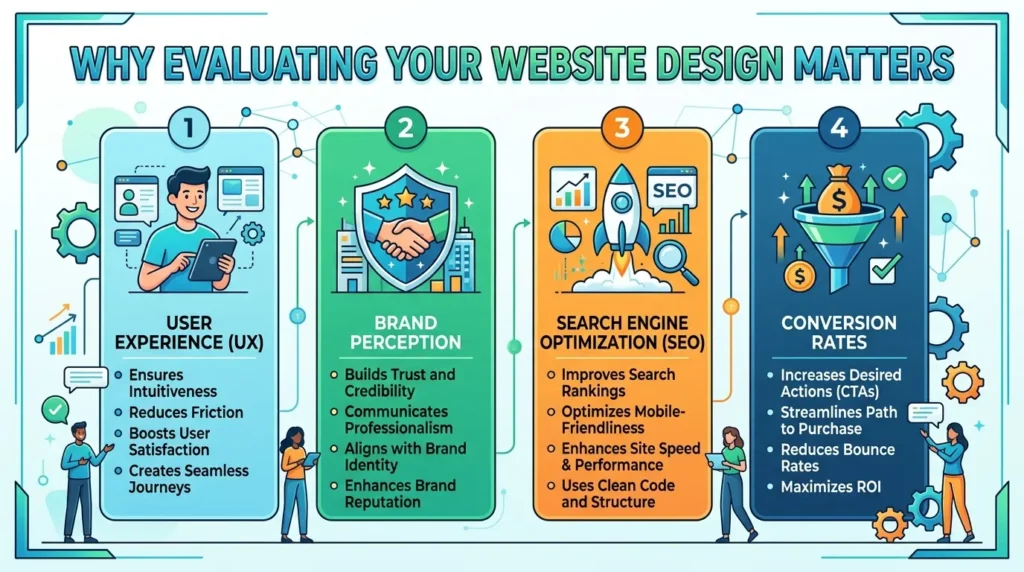
Why Evaluating Your Website Design Matters
Before diving into the process, it’s important to understand why evaluating a website design is essential:
- User Experience (UX): A website that is easy to navigate keeps users engaged and encourages conversions.
- Brand Perception: Your website reflects your business. Poor design can lead to distrust or disinterest.
- Search Engine Optimization (SEO): Google favors websites that are well-structured, fast, and mobile-friendly.
- Conversion Rates: A well-evaluated website drives higher leads, sales, or sign-ups.
Whether you are working with a custom web development company or managing your own site, evaluating your website design ensures your online presence aligns with your business goals and audience needs, particularly in competitive markets like the USA.
Step 1: Analyze Your Website’s Purpose and Goals
The first step in learning how to evaluate a website design is to identify your site’s purpose. Ask yourself:
- What action should visitors take when they land on my site?
- Is the site designed to inform, sell products, generate leads, or a combination?
- Does the design align with my brand image?
A clear understanding of your website’s goals helps determine if the current design effectively supports those objectives. For example, if your goal is to generate leads on a large scale, a professional national SEO company would ensure the design includes prominent call-to-action buttons, optimized forms, and seamless navigation.
Step 2: Evaluate User Experience (UX)
User experience is a critical component of website design evaluation. Ask these questions:
- Is the site easy to navigate?
- Are menus intuitive and consistent?
- Can users find key information quickly?
- Is the site accessible for people with disabilities?
How to Rate a Website: Rating a website is the process of quantitatively or qualitatively measuring its overall quality based on key metrics such as user experience (UX), visual appeal, page load speed, mobile responsiveness, and SEO performance to determine how effectively it meets user needs and business goals.
Checklist for UX evaluation:
- Clear navigation menu with logical structure
- Fast loading pages (2–3 seconds max)
- Mobile responsiveness across devices
- Readable fonts and balanced use of colors
- Consistent branding throughout the website
At Feynix Solution, we conduct comprehensive UX audits for clients to evaluate how to rate a website effectively, ensuring their digital platforms provide a seamless and engaging experience for American audiences who often browse on both desktops and mobile devices.
Step 3: Assess Visual Design and Branding
A visually appealing website builds trust and supports effective higher education website design evaluation.
- Are the colors, fonts, and images consistent with your brand?
- Do visual elements enhance readability or distract from the message?
- Are high-quality images and graphics used instead of generic stock photos?
- Is whitespace used effectively to prevent clutter?
Whether you are working with Professional Website Development Services or conducting a college website design evaluation, these visual evaluation tips help ensure the site leaves a lasting positive impression.
- Use a consistent color palette aligned with your brand identity
- Ensure images are optimized for web performance without sacrificing quality
- Highlight key messages using clear headings and subheadings
- Avoid excessive animations or pop-ups that may frustrate users
How Do You Evaluate a Brand Website?
When evaluating a brand website, the focus extends beyond basic design aesthetics to encompass how well the site authentically represents and reinforces your brand identity. A comprehensive brand website evaluation involves checking whether your visual elements, messaging, tone, and overall design cohesively communicate your brand’s core values and personality to visitors. The evaluation should assess if your brand colors are applied consistently across all pages, if your brand fonts are readable and distinctive, if your logo placement is strategic and immediately recognizable, and most importantly, if the website’s design direction aligns with how your target audience perceives your brand in the USA market.
Step 4: Check Website Performance and Speed
Website speed is a major factor in user satisfaction and SEO rankings, especially for USA audiences who expect fast-loading pages. To achieve these elite performance levels, a specialized front-end development agency focuses on clean code and asset optimization:
- Page load time
- Image and resource optimization
- Mobile performance
- Script and CSS efficiency
A slow website can lead to higher bounce rates and lower search engine visibility. At Feynix Solution, we optimize websites to ensure pages load quickly and smoothly across all devices.
Step 5: Evaluate Mobile Responsiveness
With mobile traffic dominating the web, evaluating mobile responsiveness is crucial. Test your website on different devices and screen sizes:
- Are menus and buttons easy to tap?
- Does the content adjust to different screen widths?
- Are images and forms responsive and readable?
When reviewing a website, performance on mobile devices is critical. A website that fails on mobile devices loses a significant portion of the audience, especially in the USA, where mobile browsing is common.
Step 6: Analyze Content and Messaging
Content is at the heart of website design. Evaluate whether your content:
- Clearly communicates your value proposition
- Uses engaging headlines and call-to-actions
- Provides useful, relevant information for your target audience
- Is free of grammatical errors and typos
Bullet Points for Content Evaluation:
- Concise, scannable paragraphs for easy reading
- Proper use of headings (H1, H2, H3) for structure
- Integration of images, videos, or infographics to enhance understanding
- Regularly updated blog posts or news sections to maintain relevance
At Feynix Solution, content is strategically aligned with design and SEO best practices to appeal to American users and search engines alike.
Step 7: Conduct SEO and Technical Audit
A visually appealing and user-friendly website is only effective if it can be found on search engines. Evaluate technical aspects such as:
- Proper use of meta tags, titles, and alt text
- Internal linking structure
- Secure HTTPS protocol
- Sitemap and robots.txt file
- Structured data for enhanced search results
Working with an experienced SEO Consultant for Startups ensures that your website not only looks great but also reaches the right audience in the USA through a comprehensive web marketing evaluation that drives targeted traffic and growth.
Step 8: Gather User Feedback
One of the most effective ways to evaluate a website design is by collecting feedback from actual users:
- Conduct surveys or usability tests
- Monitor analytics for user behavior patterns
- Identify pages with high bounce rates or low engagement
User feedback helps pinpoint real-world design and usability issues that may not be obvious during an internal review. A website critique provides a focused review of a website’s design, usability, content, and overall user experience to identify areas for improvement.
Step 9: Compare With Competitors
Understanding how your website stacks up against competitors is a key step in evaluation, particularly when utilizing Enterprise SEO Optimization Services to dominate your niche:
- Analyze design, functionality, and content strategies of top competitors
- Identify unique value propositions that your website can highlight
- Benchmark load times, mobile experience, and SEO performance
A website critique helps identify how your site compares with competitors in design, usability, content, and overall user experience.
This comparative analysis ensures your site stays competitive in the USA market.
Step 10: Implement Improvements
Finally, after evaluating every aspect, prioritize and implement improvements:
- Fix usability and navigation issues
- Optimize visuals and images
- Update content and calls to action.
- Improve mobile responsiveness and site speed
- Implement SEO enhancements
Continuous evaluation and iteration ensure that your website remains effective and aligned with evolving user expectations.
Step 11: Evaluate the User Interface of Your Website
Understanding how to evaluate user interface of a website is crucial because UI is where users actually interact with your brand. While visual design covers aesthetics and UX covers overall navigation flow, the user interface focuses specifically on interactive elements, buttons, forms, links, dropdown menus, search bars, and other clickable components that users engage with. When evaluating your website’s user interface, assess whether buttons are visually distinct and clearly indicate what happens when clicked, form fields are labeled properly with helpful error messages when users make mistakes, links are underlined or styled in a way that makes them immediately recognizable, interactive elements provide visual feedback (hover states, active states) so users know they’re clickable, form layouts are logical and minimalist to reduce friction during checkout or sign-ups, and all interactive elements are accessible via keyboard navigation for users who cannot use a mouse.
Implementing Website Evaluation Framework Best Practices
To get the most accurate and actionable insights from your review, it is essential to follow website evaluation framework best practices. Applying a standardized framework ensures that you assess usability, performance, visual branding, and technical SEO in a structured manner rather than relying on subjective opinions. Best practices include combining quantitative metrics—like page load speed and bounce rates, with qualitative user feedback, setting clear performance benchmarks before auditing, and continuously testing interactive elements across multiple screen resolutions.
Evaluating and Choosing the Right Website Development Agency
While understanding how to evaluate a website design is essential, equally important is knowing how to evaluate a website development agency that can execute these improvements effectively. A reliable website development agency should demonstrate expertise in UX optimization, mobile responsiveness, speed optimization, and SEO integration, not just aesthetic design. When selecting a partner, assess their portfolio for design quality and performance metrics, ask for case studies showing measurable improvements in client engagement and conversions, verify their understanding of industry best practices, and ensure they offer ongoing support and optimization.
The right agency doesn’t just build websites; they partner with you to create digital assets that drive real business growth. At Feynix Solution, we combine strategic evaluation insights with proven development capabilities to deliver websites that perform exceptionally across all metrics, from user experience to search engine rankings.
Key Considerations for Long-Term Development Partnerships
When building a custom digital presence, many business owners ask, “what should i consider when choosing a web development agency for long-term support?” The answer lies in looking beyond the initial launch phase[cite: 1]. You must evaluate whether the agency offers reliable technical maintenance, regular security updates, post-launch performance monitoring, and clear Service Level Agreements (SLAs). Choosing a partner committed to ongoing scalability and support ensures your website continues to perform seamlessly as your business grows
Key Criteria for How to Evaluate a Website Development Agency
Knowing how to evaluate a website development agency goes beyond just reviewing their portfolio, it requires assessing their process, expertise, and alignment with your specific business needs. When evaluating potential development partners, look for several critical indicators: Do they ask detailed discovery questions about your business goals, target audience, and competitive landscape before proposing solutions? Can they demonstrate expertise across technical requirements like responsive design, page speed optimization, security implementation, and SEO architecture? Do they provide transparent timelines and realistic project estimates, or do they make vague promises? Ask for references from past clients and verify whether their websites are still actively maintained and performing well.
How to Compare Website Design Companies Based on Turnaround Time and Quality?
When evaluating potential development partners, balancing speed and delivery standards is critical. To know how to compare website design companies based on turnaround time and quality, examine their project milestones, code standards, and QA testing workflows. A top-tier design agency delivers projects within tight schedules without compromising mobile responsiveness, site performance, or custom visual appeal. Always review client case studies and demand clear project roadmaps to ensure the company delivers high-quality assets on time.
How does this visual headless cms compare to wordpress?
While traditional WordPress relies on a coupled architecture where content and visual templates are tightly bound, a visual headless CMS bridges the gap between editorial freedom and modern API-driven performance. Unlike WordPress, where visual editing is constrained by theme structures, PHP logic, or heavy page builders that can slow down your site, a visual headless CMS gives marketers a drag-and-drop, real-time preview experience while serving structured data to developers. This means you get the fast, user-friendly visual page building of WordPress alongside the high speed, enterprise-grade security, and multi-channel content distribution of a decoupled headless system.
The Foundation: How to Analyze a Website Design Effectively
Before jumping into specific steps, it’s important to understand the fundamental approach to how to analyze a website design. Analysis is a systematic process that goes beyond surface-level observations, it requires examining design elements, user interactions, technical performance, and business alignment simultaneously. Start by creating a structured analysis framework based on key website analyse criteria, including visual hierarchy, navigation flow, content organization, load speeds, and conversion pathways.. Many business owners think analysis means just looking at a website, but true analysis involves data collection through analytics tools, user behavior tracking, and competitive benchmarking.
Choose Your Right Partner
Choosing the right digital partner can make all the difference in achieving your business goals. In today’s competitive online landscape, you need a team that understands your vision, offers innovative solutions, and delivers measurable results. Feynix Solution is committed to being that trusted partner for businesses in the U.S. With expertise in web and mobile app development, SEO, and digital marketing, Feynix Solution ensures that your website and digital presence are not only visually appealing but also strategically optimized for growth. Partnering with the right team means less stress, better results, and a strong foundation for long-term success.
Our Client Reviews
Following this guide on how to evaluate a website design helped us dramatically improve our UX and mobile responsiveness within weeks.
— Daniel R., Business Owner
Feynix Solution’s evaluation process showed us exactly where our website was underperforming. The improvements boosted engagement and conversions.
— Jennifer M., Marketing Director
We didn’t realize how speed and structure were hurting our SEO. After applying these evaluation steps, our traffic improved significantly.
— Christopher L., Startup Founder
Clear, practical, and actionable. This approach made evaluating our website simple and effective.
— Amanda S., E-Commerce Manager
People Also Asked
Final Thoughts
Understanding how to evaluate a website design is essential for businesses that want to compete in today’s digital-first USA market. A high-performing website must balance visual appeal, seamless UX, strong technical performance, and SEO optimization. By analyzing design structure, mobile responsiveness, speed, content clarity, and search visibility, you ensure your website supports real business goals, not just aesthetics. At Feynix Solution, we help businesses turn underperforming websites into growth-driven digital assets. Through structured audits, UX improvements, and performance optimization, we ensure your website attracts, engages, and converts effectively.
If you want to learn about How Long Does an SEO Audit Take, you can visit our page for a detailed guide and expert tips.
Author
Feynix Solution Team – The Feynix Solution Team specializes in web and mobile app development, digital marketing, and website evaluation. With years of experience helping businesses across the United States optimize their online presence, the team shares actionable insights to improve UX, design, and digital performance.
Have questions or need expert guidance? Contact us today to take your website and digital presence to the next level!