
Most e-commerce stores look nice but don’t convert. Visitors browse, add items to cart, then abandon. The site works fine technically, but it doesn’t drive revenue. This is where strategy matters more than aesthetics. Building truly effective shopify web development services requires understanding what actually converts customers. It’s not just about creating beautiful product pages, it’s about engineering entire experiences that move people from browsing to buying.
At Feynix Solution, we specialize in building Shopify stores engineered specifically to drive conversions, enhance customer experience, and scale alongside your business growth. This guide explains what separates high-performing stores from mediocre ones.
Why E-Commerce Businesses Choose Shopify
Shopify became the leading platform for online businesses for good reasons. The platform handles complexity that other systems make difficult.
You can:
- Launch stores quickly without extensive technical setup.
- Manage inventory, orders, and fulfillment from a central dashboard.
- Integrate payment gateways, shipping tools, and marketing platforms seamlessly.
- Scale from small operations to enterprise-level operations without rebuilding.
- Access a massive ecosystem of third-party apps that extend functionality.
- Benefit from Shopify’s infrastructure handling security, speed, and reliability.
Shopify removes infrastructure friction. But having a powerful platform doesn’t guarantee sales. What determines results is how you build your Shopify store. A poorly built store on Shopify still underperforms, whereas hiring an experienced Web Development Company ensures a well-designed store that converts aggressively.
The Real Problem: Most Shopify Stores Don’t Optimize for Conversions
Here’s what we see frequently: businesses invest in Shopify stores, but they optimize for things that don’t matter.
They focus on:
- Flashy animations that slow down page load.
- Generic product descriptions copied from suppliers.
- Cluttered navigation confusing visitors.
- Missing trust signals like reviews or security badges.
- Checkout processes requiring unnecessary steps.
- Mobile experiences designed as afterthoughts.
These stores attract traffic but lose customers constantly. Visitors leave frustrated. Cart abandonment climbs. The business owner blames the platform. But the platform isn’t the problem—the build strategy is.
What High-Converting Shopify Stores Actually Do
Effective shopify web development services focus on fundamentals that drive revenue:
- Fast Page Load Times Matter Tremendously Slow stores lose customers. Research shows even 1-second delays reduce conversions. Modern Shopify development optimizes images, minimizes code, and leverages caching because speed directly impacts sales. Google rewards fast sites with better search rankings. Your customers reward fast checkout with purchases.
- Mobile-First Design Is Non-Negotiable Most e-commerce traffic comes from phones. If your Shopify store works poorly on mobile, you’re losing the majority of your potential customers. Proper development ensures every experience, browsing, product viewing, checkout, works flawlessly on all devices.
- Product Pages Require Strategic Thinking Your product pages are your sales team. They need clear descriptions explaining benefits, high-quality images showing products accurately, social proof through customer reviews, and obvious call-to-action buttons. Vague product pages that list specifications don’t convert. Strategic product pages that emphasize value do.
- Checkout Simplicity Reduces Abandonment Complex checkout processes kill conversions. Every extra step means lost customers. Good Shopify development streamlines checkout: fewer required fields, clear progress indicators, multiple payment options, guest checkout capability, and security badges building trust.
- Real-Time Customer Support Improves Sales Website chatbots integrated into Shopify answer common questions instantly. Customers ask about shipping costs, return policies, or product details, chatbots respond immediately. This reduces friction and answers objections before customers leave. Additionally, chatbots reduce customer service costs while improving satisfaction metrics.
- Trust Signals Determine Whether Visitors Buy Customers buying online face risk. They want confidence you’re legitimate. Effective Shopify stores display customer reviews prominently, show security certifications, explain return policies clearly, display trust badges, and make contact information obvious. These signals overcome purchase hesitation.
- Want to start selling online without holding any inventory? Read our complete tutorial on How to Setup a Shopify Dropshipping Store to launch your business today.
How Shopify Web Development Services Should Actually Work
Building high-converting Shopify stores requires systematic thinking across multiple areas:
Effective shopify website development services should cover strategy, store architecture, integrations, performance optimization, and ongoing conversion testing rather than focusing only on the visual design.
- Discovery and Strategy Phase Before building anything, understand your business model, your customer journey, your competitive landscape, and your specific growth goals. A developer jumping straight to building without strategy creates generic stores. Strategic development starts with questions: Who are your customers? What motivates their purchases? What confuses them? What keeps them from buying? Answers to these questions shape everything that follows.
- Store Architecture and Theme Selection Most builders use out-of-the-box themes and call it done. Strategic Shopify development customizes themes or builds custom ones reflecting your brand identity while optimizing for conversions. This means intentional navigation structures, strategic product page layouts, and checkout flows designed to reduce abandonment.
- Content and Product Strategy Product descriptions matter enormously. Generic supplier descriptions don’t convert. Strategic content explains benefits, addresses customer concerns, shows use cases, and emphasizes value. Product photography quality determines whether visitors trust products enough to purchase. Strategic Shopify development ensures content quality, not just existence.
- Third-Party Integration and Automation Modern Shopify stores integrate with email marketing platforms, inventory management systems, analytics tools, CRM systems, and fulfillment services. These integrations eliminate manual work and provide visibility into customer behavior. Proper integration enables data-driven decisions. Poor integration creates information silos.
- Performance Optimization Site speed matters for conversions and search rankings. Optimization includes image compression, code minification, caching strategies, and content delivery networks. Pages that load in 1-2 seconds convert significantly better than pages taking 4+ seconds.
- Conversion Rate Testing High-converting stores aren’t built once and forgotten. They improve continuously through testing. Changes to product page layouts, button colors, copy, checkout processes, and trust signals are tested methodically. Data determines which variations actually improve conversions. Gut feelings don’t.
Real Results From Strategic Shopify Development
When businesses partner with developers focused on conversions instead of just features:
- Conversion rates improve 20-40% within the first 3-6 months through optimization
- Average order value increases as strategic upselling and product recommendations appear
- Cart abandonment decreases as checkout friction gets removed
- Customer lifetime value improves as repeat purchase experiences improve
- Organic search traffic grows as Shopify stores become properly optimized for SEO
These outcomes don’t happen accidentally. They happen through methodical strategy, technical expertise, and continuous improvement. A slow website costs you lost sales every day. Read our actionable tips on How to improve Shopify store speed to boost your conversion rates and customer satisfaction.
Shopify Web Development Services: What to Evaluate
When choosing developers for your Shopify store, evaluate:
- Do They Ask Strategic Questions First? Developers who start coding immediately aren’t thinking strategically. Good partners ask about your business, customers, goals, and challenges before suggesting solutions.
- Do They Focus on Conversions or Just Aesthetics? Beautiful stores that don’t convert are common. Smart developers balance aesthetics with conversion optimization. They can explain why specific design choices improve sales.
- Can They Explain Performance Metrics? Ask about page load speed, Core Web Vitals, conversion rates, and customer lifetime value. Developers who only discuss design elements miss critical success factors.
- Do They Handle the Full Shopify Ecosystem? Good Shopify development includes theme customization or creation, app integration, payment gateway setup, analytics implementation, and ongoing optimization. Partners handling only design or only backend don’t deliver complete solutions.
- Do They Understand the U.S. Market?
If you’re targeting American customers, choosing a shopify website development company in USA can make it easier to align your store with local customer expectations, integrations, and e-commerce requirements - Will They Improve After Launch? Stores improve continuously. Ask whether partners provide ongoing support, monitor performance, and continuously test improvements. Developers who hand off completed projects miss optimization opportunities.
Avoiding Common Shopify Development Mistakes
Many businesses waste money on Shopify stores built incorrectly. Avoid:
- Prioritizing Design Over Conversions Beautiful stores that don’t convert waste money. Conversions matter more than perfect pixels.
- Ignoring Mobile Optimization Mobile-first isn’t optional anymore. Phones generate most e-commerce traffic.
- Skipping Performance Optimization Slow stores lose customers and search rankings. Speed optimization is essential, not optional.
- Building Without Strategic Content Product descriptions matter. Shopify stores need quality content explaining benefits, not supplier specs.
- Launching and Forgetting Successful stores improve continuously. Set-and-forget approaches leave revenue on the table.
- Neglecting Analytics You can’t improve what you don’t measure. Implement analytics from day one.
- Page speed directly impacts your conversion rate, and choosing the right layout is critical. Learn more in our article Does Shopify theme affect store speed? before making your next design update.
How Feynix Solution Approaches Shopify Development
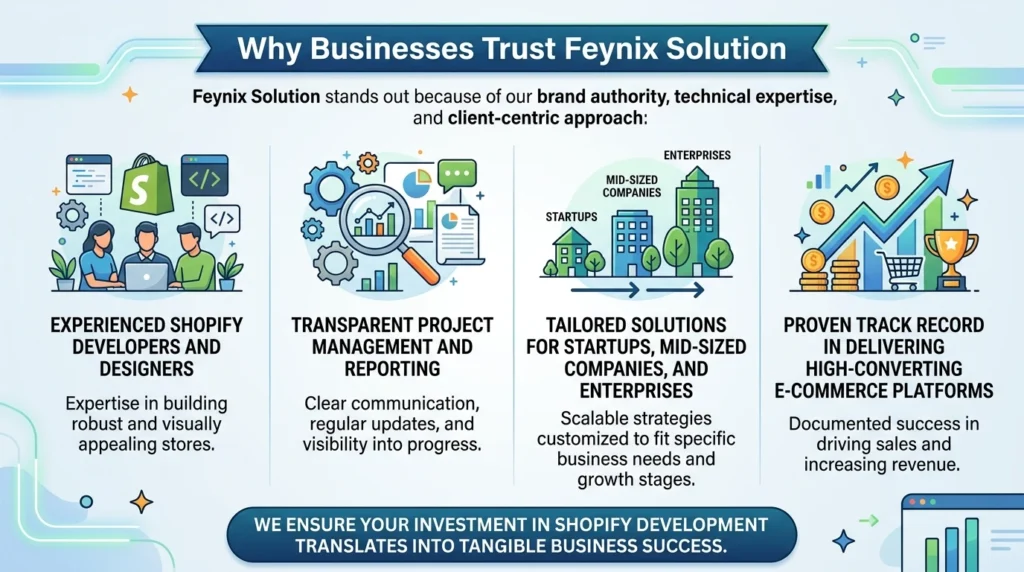
Feynix Solution refuse to treat Shopify stores as design projects. We treat them as revenue systems. This mindset shapes everything we do. Before we write a single line of code or design a single page, we spend substantial time understanding your business, your customers, your market position, and your growth goals. This approach makes our shopify web development services in USA more focused on business goals, customer needs, and long-term store performance.
We ask difficult questions:
- Who are your customers and what actually motivates their purchases?
- What objections prevent people from buying?
- Where do visitors abandon during their journey?
- What competitors do you actually compete against?
- What’s your realistic growth target for the next 12-24 months?
- How does your team want to manage the store post-launch?
Most agencies skip this phase. Feynix Solution spends 2-3 weeks on discovery because strategy built on assumptions fails. Strategy built on understanding succeeds.
People Also Ask
Q: How much does Shopify web development cost?
Shopify store development varies based on complexity and customization. Basic store builds start around $2,000-$5,000. Stores requiring custom features, extensive integrations, or specialized functionality cost $5,000-$15,000+. However, view this as investment, not expense. A conversion-focused Shopify store typically generates ROI within months through increased sales. The real question isn’t “How much does it cost?” but “What’s the revenue impact?”
Q: How long does Shopify development take?
Timeline depends on complexity and customization scope. Basic stores launch within 4-8 weeks. Custom stores with multiple integrations take 8-12 weeks. However, building a store is just the beginning. Real optimization happens post-launch through testing, monitoring, and continuous improvement.
Q: Can Shopify web development services improve my existing store’s sales?
Absolutely. Most existing stores have significant conversion optimization opportunities. Audits typically uncover slow pages, confusing navigation, weak product descriptions, and checkout friction. Addressing these issues often improves conversions 20-40% without major rebuilds. Sometimes strategic redesigns make sense, but optimization often delivers results faster and cheaper.
Q: How important is mobile optimization for Shopify stores?
Critical. Over 60% of e-commerce traffic comes from mobile devices. Stores optimized for desktop but not mobile lose the majority of potential customers. Modern Shopify development prioritizes mobile-first design because that’s where your customers actually shop.
Q: Should I use Shopify apps or custom development?
Both. Shopify’s app ecosystem handles common needs cost-effectively: email marketing, analytics, product recommendations, chatbots. Custom development handles unique requirements specific to your business. Balancing pre-built apps with custom functionality delivers the best economics.
Building Shopify Stores That Generate Revenue
The difference between high-performing stores and mediocre ones isn’t platform choice, it’s how strategically they’re built and optimized. Feynix Solution specializes in Shopify development that combines technical expertise, conversion focus, and continuous improvement. We build stores designed to drive sales from day one, then optimize relentlessly based on data. From initial strategy and custom store development to post-launch optimization and ongoing support, we handle the complete Shopify journey.
Ready to build a Shopify store that converts? info@feynixsolution.com
Let’s discuss your e-commerce goals and what high-performing Shopify store development looks like for your business.
About Feynix Solution
Feynix Solution specializes in building Shopify stores engineered for conversions. With years of experience developing high-performing e-commerce experiences, our team combines technical expertise with conversion psychology and data-driven optimization. We build stores that don’t just look good—they generate revenue and scale sustainably.